
logo
  • Projects
  • Articles
logo
  • Projects
  • Articles
Youssef Wael logo

Front-End development and UI engineering with a focus on performance, clarity, and conversion.

Navigation

  • Home
  • Projects
    Front-endReact.jsNext.jsUI/UXWordpress
  • Articles
    FrontendBackendWordPressArtificial IntelligenceDevOps & HostingBusiness & TechDev Tools
  • Services
  • About
  • Contact

Social

©

© 2026 Youssef Wael. All rights reserved.

Essential API Security Best Practices for 2024

Essential API Security Best Practices for 2024

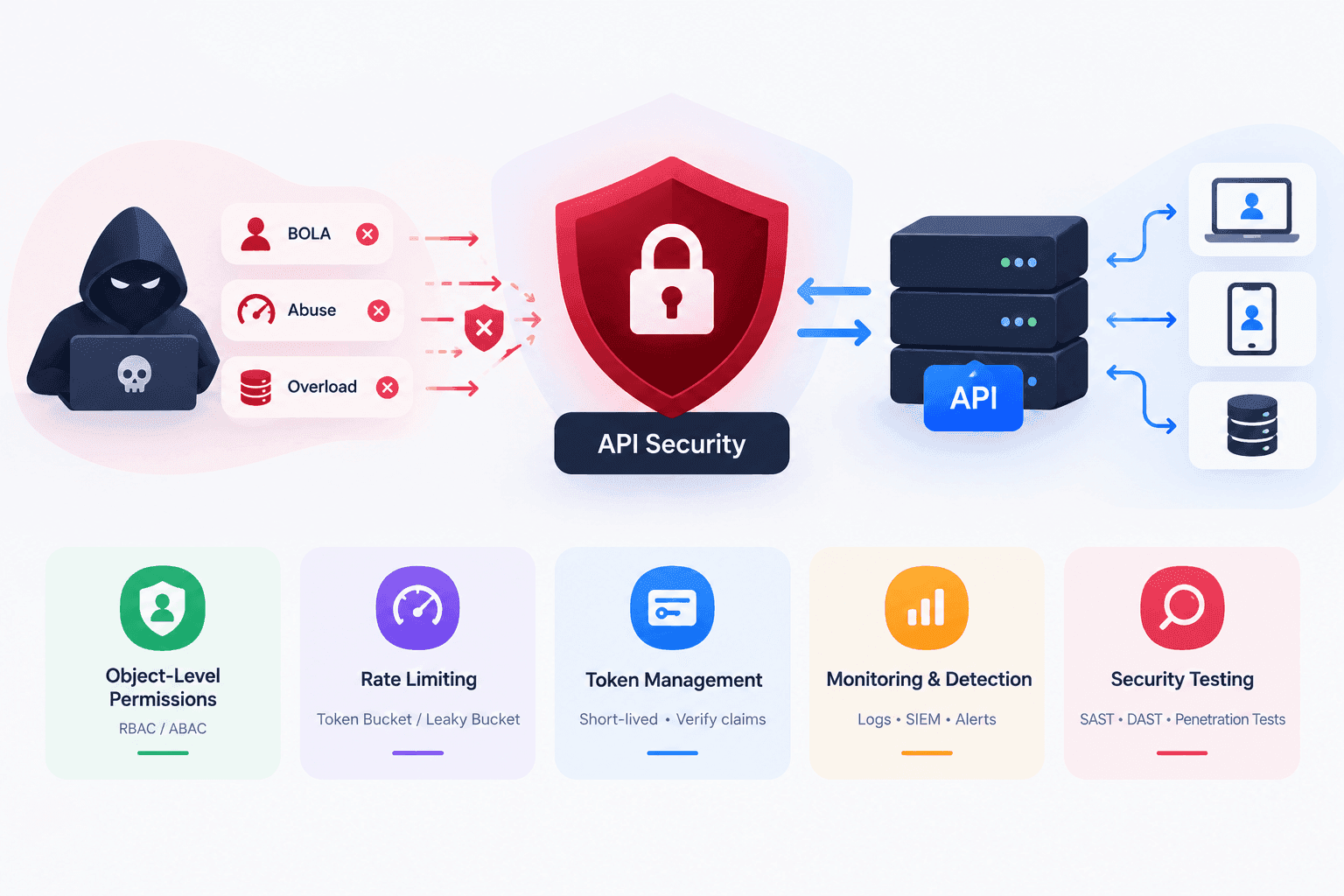
Learn how to protect API endpoints in 2024 against BOLA attacks, abuse, and overload with practical rate‑limiting and authorization strategies.

August 22, 2026
Share

Why API Security Matters in 2024

Modern applications rely heavily on APIs to exchange data. A breach can expose sensitive information, compromise services, and damage brand reputation. Securing each endpoint is therefore non‑negotiable.

Threat Spotlight: Broken Object‑Level Authorization (BOLA)

  • Occurs when a user can access resources they are not authorized to view.
  • Real‑world example: an API call to `/orders/987` returns another user's order because the server fails to verify object ownership.

Rate Limiting as a First Line of Defense

  • Controls the number of requests a client can make within a time window.
  • Thwarts denial‑of‑service attacks and reduces the attack surface for BOLA exploitation through rapid trial‑and‑error.

Core Best Practices Checklist

1. Enforce strict object‑level permissions

  • Implement RBAC or ABAC policies that validate the object's owner on every request.

2. Deploy adaptive rate limiting

  • Use Token Bucket or Leaky Bucket algorithms.
  • Set different limits for public, partner, and internal consumers.

3. Harden token management

  • Issue short‑lived access tokens with secure signing keys.
  • Validate `exp`, `nbf`, and audience claims on each request.

4. Continuous monitoring and anomaly detection

  • Log request metadata: user ID, endpoint, timestamp, and response status.
  • Feed logs into a SIEM platform to spot spikes or unusual patterns.

5. Regular security testing

  • Conduct penetration tests that specifically target BOLA and rate‑limit bypass scenarios.
  • Integrate SAST and DAST tools into the CI/CD pipeline.

Quick Implementation Steps

  • Audit every endpoint to confirm object‑level checks are in place.
  • Add a rate‑limit plugin to your API gateway (Kong, Envoy, or AWS API Gateway).
  • Rotate JWT signing keys every 90 days and enforce token revocation lists.
  • Create a Grafana dashboard showing request rates, error codes, and alert thresholds.

By following these API security best practices, organizations can defend against modern threats, maintain performance, and keep their data pipelines secure throughout 2024.

Related articles

Beyond Basic Caching: Implementing Multi-Level Cache Strategies for High-Performance Backends

Beyond Basic Caching: Implementing Multi-Level Cache Strategies for High-Performance Backends

August 22, 2026

A technical deep-dive into architecting a multi-level caching strategy using CDN, Redis, and database query caching for low-latency systems.

Microservices vs Monolithic Architecture: A Comprehensive Guide for Scalable Software Development

Microservices vs Monolithic Architecture: A Comprehensive Guide for Scalable Software Development

August 22, 2026

Discover the core differences between microservices and monolithic architectures, and learn how to choose the right pattern for your software project based on team size and growth goals.

MongoDB vs SQL: Key Differences and Which Database to Choose

MongoDB vs SQL: Key Differences and Which Database to Choose

August 13, 2026

Discover the key differences between MongoDB and SQL databases, including data structure, scalability, performance, relationships, and the best use cases.

What is Express.js? How It Works and Why It Became the Most Popular Node.js Framework

What is Express.js? How It Works and Why It Became the Most Popular Node.js Framework

July 31, 2026

Learn what Express.js is, how it works, and why it's the most popular framework for Node.js. Discover its features, benefits, middleware, routing, and why developers use it to build fast and scalable web applications and REST APIs.

What is Appwrite? The Fast Way to Build a Complete Backend for Modern Applications

What is Appwrite? The Fast Way to Build a Complete Backend for Modern Applications

February 8, 2026

Appwrite is an open-source Backend-as-a-Service (BaaS) platform everything you need to build a powerful backend without dealing with complex server setups.

Backend