
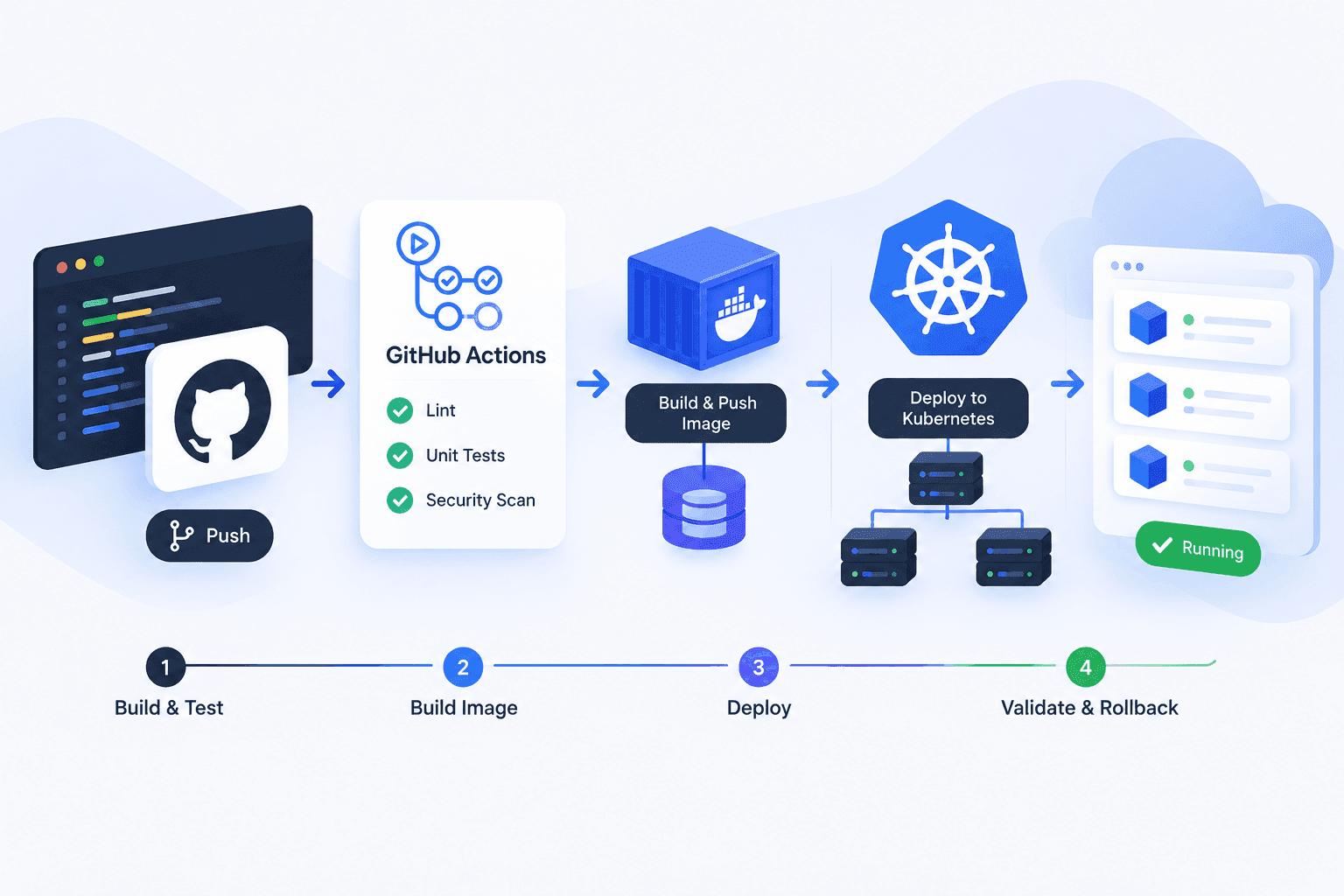
Efficient CI/CD pipeline implementation is essential for managing the complexity of cloud-native microservices. By automating the build, test, and deployment phases, development teams can deliver updates faster and with higher reliability. This tutorial focuses on the synergy between GitHub Actions and Kubernetes to create a seamless deployment flow.
Step 1: Containerizing the Application
The foundation of a cloud-native pipeline is containerization. Each microservice must have a dedicated Dockerfile that defines its environment and dependencies. During the initial stage of the pipeline, the system builds these Docker images. Using multi-stage builds is a best practice here to ensure that the final production image is lightweight and secure, containing only the necessary runtime components.
Step 2: Orchestrating Workflows with GitHub Actions
GitHub Actions serves as the automation engine. You define your workflow in a YAML file within the repository. This file specifies triggers, such as a push to the main branch or a pull request. The workflow should include jobs for linting, running unit tests, and security scanning. Only after these checks pass does the pipeline proceed to build the container image and push it to a private or public registry.
Step 3: Deploying to Kubernetes Clusters
The final stage of CI/CD pipeline implementation involves updating the Kubernetes cluster. The pipeline uses stored secrets to authenticate with the cluster API. It then updates the Kubernetes deployment manifests or Helm charts with the new image tag. Using rolling updates ensures that the application remains available during the transition, as Kubernetes replaces old pods with new ones incrementally.
Step 4: Validation and Rollback Strategies
Automation does not stop at deployment. Post-deployment health checks are vital to verify that the new pods are ready to accept traffic. If the health checks fail, the pipeline should be configured to trigger an automatic rollback to the previous stable version. This safeguards the production environment against unforeseen regressions or configuration errors.
Conclusion
Successful CI/CD pipeline implementation transforms how teams manage microservices. By leveraging GitHub Actions for automation and Kubernetes for orchestration, you create a resilient system that supports rapid iteration and high availability. This approach minimizes manual errors and allows developers to focus on writing code rather than managing infrastructure.